
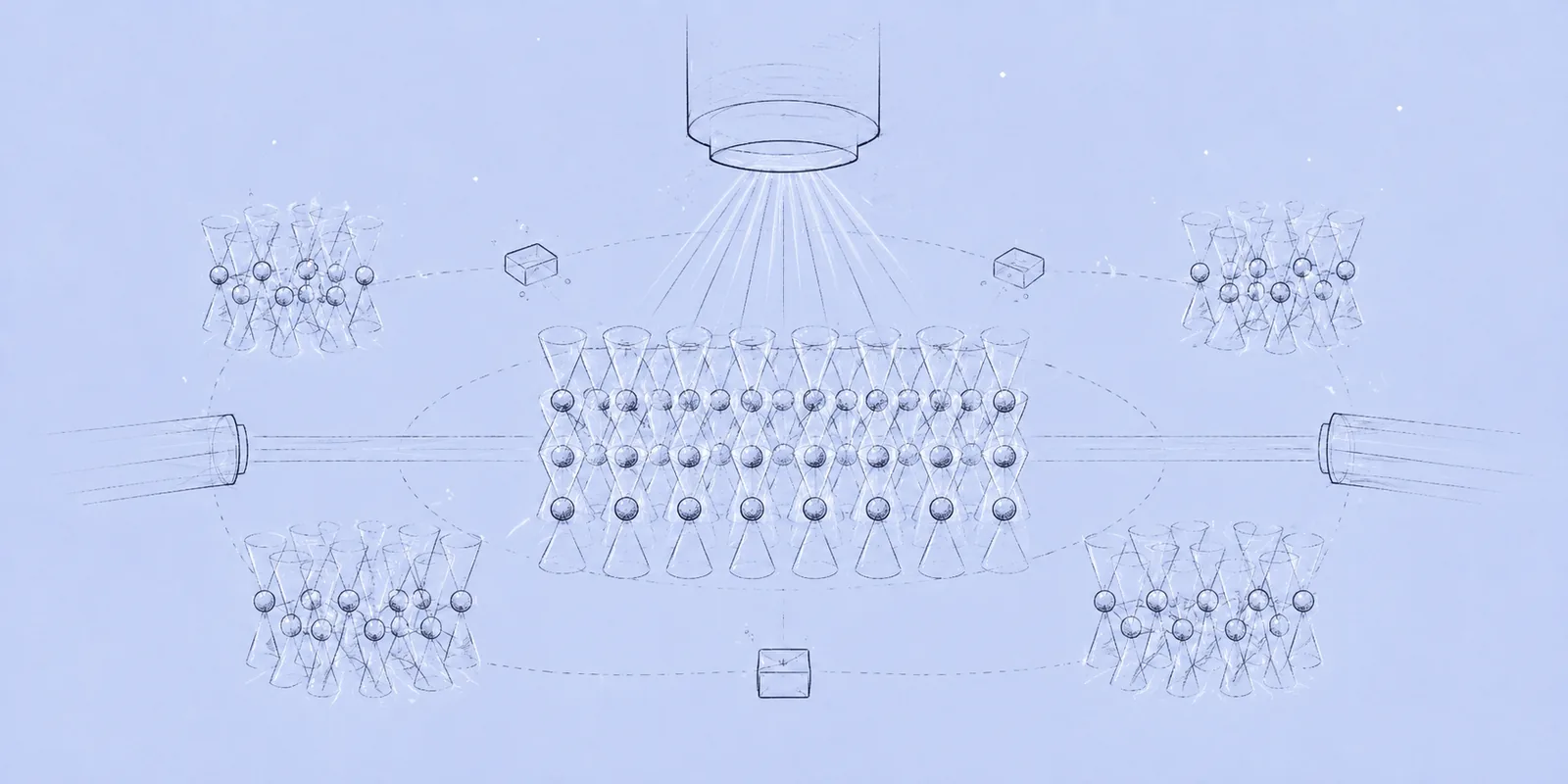
Evidence notation: “Vault” refers to the patent and semantic-search findings supplied from the Strata IP Vault. “External” refers to independently reviewed primary scientific papers and official company/university disclosures. Patent counts are treated as directional unless assignee normalization and family deduplication have been completed.
Executive summary
The Strata IP Vault points to a neutral-atom patent landscape that is young, concentrated and unusually intertwined with academia. That finding is directionally consistent with the external record: many of the platform’s most important advances—from coherent atom transport and logical processors to transversal fault tolerance—have emerged from university-led teams and have then been commercialized through companies such as QuEra and CavilinQ.
The strongest strategic signal is not simply “neutral atoms are scalable.” It is that the platform turns physical mobility, detectable atom loss and programmable geometry into architectural resources. These properties create advantages that are difficult to reproduce directly in fixed solid-state qubit arrays, but they also create new engineering costs: atom loading, shuttling, laser complexity, crosstalk, reloading latency and optical interconnect overhead.
External science strongly validates the Vault’s emphasis on atom logistics. Harvard-led work demonstrated coherent continuous operation of more than 3,000 physical qubits with reloading of up to 30,000 initialized qubits per second (Chiu et al., 2025), while Atom Computing’s 2026 toric-code work explicitly uses mid-circuit measurement and replacement of lost atoms across repeated error-correction cycles (Atom Computing, 2026). This moves “reloading” from a laboratory inconvenience to a core systems primitive.
The second validated signal is erasure conversion. Theory and experiment show that neutral atoms can sometimes convert otherwise ambiguous faults into detectable erasures, errors whose locations are known (Wu et al., 2022). Work from Princeton/Yale and collaborators has quantified substantially higher code thresholds under biased-erasure noise (Sahay et al., 2023), while ytterbium experiments demonstrated mid-circuit erasure detection (Ma et al., 2023). Harvard/QuEra and Atom Computing are now incorporating loss awareness directly into logical-computing architectures.
The third signal is an emerging architecture war. Harvard/QuEra emphasize reconfigurable arrays, transversal gates and movement-enabled connectivity (Bluvstein et al., 2024, 2025). In parallel, recent proposals and Infleqtion-linked research explore stationary or global-control architectures that reduce movement and local-addressing requirements (Cesa and Pichler, 2023; Poole et al., 2025). A third path, represented by University of Chicago work and CavilinQ, treats photonic interconnects between atom-array processors as the scaling layer (Menon et al., 2024; CavilinQ, 2026).
For competitive assessment, patent counts alone will understate several players. ColdQuanta and Infleqtion must be normalized as the same corporate lineage. QuEra’s university-linked IP can sit under Harvard/MIT co-assignment. CavilinQ’s commercial position is visible first through university research and company formation rather than a mature assignee portfolio. Pasqal’s patent activity appears broad and application-heavy in the Vault, but its public roadmap now explicitly targets fault-tolerant logical qubits, so the current commercial intent is broader than a static CPC count may imply.
| Finding | Vault signal | External validation | Assessment |
|---|---|---|---|
| Atom logistics | Multiple filings on transport, defect-free loading and continuous reloading | 3,000-qubit continuous-operation experiment; repeated QEC with qubit replacement | Strongly validated |
| Addressing / control | Dense activity around AOD/SLM, fibre channels and parallel/global gates | Universal globally driven Rydberg proposals; individual-addressing demonstrations; dual-species work | Validated; multiple architectural answers |
| Erasure conversion | Harvard / Princeton / Atom / ColdQuanta cluster | PRX / Nature / Atom Computing literature shows erasure-aware codes and experiments | Strongly validated |
| Harvard / Chicago split | Harvard = logical architecture; Chicago = control / interconnect | Nature Communications atom–nanophotonic interface + spectator-qubit Science work | Validated |
| CavilinQ thesis | Vault lacked direct assignee evidence | Company launched around cavity-enhanced photonic interconnects; $8.8M seed announced Apr. 2026 | Externally confirmed |
| Pasqal = mostly analog / applications | Vault CPC / problem statements skew toward algorithms and enabling hardware | Public roadmap now explicitly includes FTQC and logical-qubit targets | Needs nuanced interpretation |
1Why neutral atoms matter
Neutral-atom computers use individual atoms—typically held in optical tweezers—as physical qubits. Entangling operations are commonly mediated by excitation to Rydberg states, where atoms interact strongly over micrometre-scale distances. The basic attraction is straightforward: atoms are naturally identical, arrays can be large, geometry can be reconfigured, and qubits can sometimes be physically transported instead of relying on fixed nearest-neighbour couplers.
This combination has produced a distinctive progression. Early systems were best known for analog quantum simulation and optimization. More recent systems now demonstrate high-fidelity digital gates, logical qubits, mid-circuit measurement, qubit reloading and fault-tolerant building blocks. The platform is therefore shifting from “large analog arrays” toward a competition over which neutral-atom architecture can support deep logical computation.
2Evidence model and limitations
This report combines two evidence layers. The first is the Strata IP Vault analysis supplied for this study: patent-family counts, assignee searches, semantic topic hits, CPC concentrations and problem/solution statements. The second is external validation from primary scientific literature and official company or university disclosures available through August 2026.
- Patent counts are directional, not definitive. Assignee aliases, co-assignment, jurisdiction coverage and family duplication can materially change totals.
- Publication year is not equivalent to filing strategy. For portfolio-timing analysis, earliest priority dates should be used wherever possible.
- Scientific proximity is not a patent-validity or freedom-to-operate conclusion. A related paper can validate a technical theme without anticipating a claim.
- Company roadmaps describe intent, not guaranteed delivery. They are useful for competitive positioning but should not be treated as demonstrated performance.
3The Vault’s central finding: the field is young, concentrated and academically anchored
The Vault returns a neutral-atom patent cluster dominated by recent filings and a relatively small number of assignees compared with mature superconducting portfolios. Within that dataset, Pasqal and Atom Computing appear as the largest direct corporate filers, while Harvard/MIT-linked work dominates many architecture and error-correction topic hits. QuEra appears more often through co-assignment and the Harvard lineage than through a simple company-name search. Infleqtion is materially undercounted unless the former ColdQuanta name is merged.
| Player / lineage | Vault observation | Interpretation after external validation |
|---|---|---|
| Harvard / MIT / QuEra | Architecture, transversal gates, modular Rydberg and logical-processing hits | QuEra explicitly states that its technology is based on patented research of Harvard/MIT scientific co-founders; the university–company boundary is real, not noise. |
| Atom Computing | Transport, loading, cold-atom architecture, erasure operations | External work now includes 256-Yb logical computation and 2026 repeated toric-code QEC with qubit replacement. |
| Pasqal | Large recent portfolio; hardware control + substantial algorithm/application activity | Still commercially committed to analog/digital applications, but the official roadmap now targets FTQC and large logical-qubit systems. |
| Infleqtion / ColdQuanta | Sparse under “Infleqtion,” much larger under the legacy name | The official 2022 rebrand confirms alias normalization is mandatory; the current company also reports a large neutral-atom computing program. |
| Chicago / Bernien / Menon / CavilinQ | Control, spectator qubits and atom–photon interface rather than core QEC | External work confirms a distinct modular-networking and nanophotonic-interconnect thesis now being commercialized by CavilinQ. |
4Bottleneck #1: atom logistics is becoming a systems discipline
The Vault’s strongest hardware theme is not gate design but atom logistics: loading, rearrangement, transport, defect repair and reloading. Examples include Atom Computing transport filings, Harvard continuous-reload concepts, and university work on defect-free preparation with dynamic optical tweezers. The repeated appearance of the same problem across unrelated assignees is a strong sign that the bottleneck is architectural rather than company-specific.
External evidence strongly supports that interpretation. A 2025 Nature paper demonstrated continuous coherent operation of more than 3,000 physical qubits while introducing new atoms without destroying the stored quantum information; the reported reloading rate reached up to 30,000 initialized qubits per second (Chiu et al., 2025). In 2026, Atom Computing reported repeated toric-code error-correction cycles using mid-circuit measurement and replacement of lost qubits, including reservoir reloading for indefinite coherent operation (Atom Computing, 2026).
| Vault example | Problem attacked | External corroboration |
|---|---|---|
CN-120338130-A |
Fill vacancies in an initially defective tweezer array | Large-array experiments increasingly treat rearrangement as a standard preparation primitive. |
US-20250378972-A1 Atom Computing |
Separate loading and computation zones through atom transport | Atom Computing’s logical-computation work relies on movement-enabled all-to-all connectivity and loss correction. |
WO-2025255376-A1 Harvard |
Continuous reservoir-side reloading | Nature 2025 demonstrates continuous coherent operation and high-rate qubit reloading. |
5Bottleneck #2: the field is trying both to scale addressing—and to eliminate it
A second dense Vault theme concerns individual optical control. One path scales the optics: fibre arrays, modulators, AOD/SLM systems, interferometric channel banks and integrated emitters. The opposite path tries to avoid local addressing by using global pulses, species selectivity, blockade geometry or stationary relay structures.
The external literature confirms that this is an active architecture choice rather than an incremental engineering detail. A 2023 proposal showed universal computation using globally driven dual-species Rydberg arrays without local addressing (Cesa and Pichler, 2023). A 2026 measurement-free toric-code proposal goes further: no atom motion, no mid-circuit measurement and no local addressing, instead using species-selective global pulses (Wang et al., 2026). Another 2026 compiler/architecture proposal, BRIDGE, keeps data atoms stationary and routes interactions through buffer atoms, reporting large simulated gains under its chosen error model (Huang et al., 2026).
| Scaling philosophy | Core idea | Representative evidence | Main risk |
|---|---|---|---|
| Scale local optics | More channels, better modulators, tighter integration | Vault: Chicago fibre array; Pasqal AOD/SLM alternatives. External: individual-addressing neutral-atom processors | Optical complexity and crosstalk |
| Use global control | Encode computation in geometry/species and global pulses | Globally driven Rydberg proposals; 2026 measurement-free toric-code proposal | Atom/species overhead and control-model constraints |
| Keep data stationary | Use long-range or relay interactions instead of shuttling data | Infleqtion/Wisconsin qLDPC proposal; 2026 BRIDGE architecture | Requires strong, well-calibrated nonlocal interactions |
6Bottleneck #3—and possible advantage: erasure conversion
The richest technical convergence in the Vault is erasure conversion: converting a physical error into an event whose location is known. This matters because a decoder can correct a known-location loss much more efficiently than an unknown Pauli error of comparable probability.
The external science trail is unusually coherent. Wu, Kolkowitz, Puri and Thompson proposed an alkaline-earth neutral-atom encoding in which dominant errors leave the qubit subspace and become optically detectable; their simulations estimated that a large fraction of faults could be converted to erasures and substantially increased the surface-code threshold (Wu et al., 2022). Sahay, Jin, Claes, Thompson and Puri then studied biased erasure noise and reported thresholds of 8.2% for an XZZX surface-code setting and 10.3% for a hybrid-fusion construction under their model (Sahay et al., 2023). Experimental work with metastable 171Yb subsequently demonstrated high-fidelity gates with mid-circuit erasure detection (Ma et al., 2023).
This concept is now migrating from theory into system architecture. Atom Computing and Microsoft demonstrated logical computation on 256 ytterbium atoms, including lost-qubit correction. Harvard’s later fault-tolerant architecture explicitly leverages atom-loss detection alongside repeated QEC and transversal operations. The competitive question is therefore shifting from “can loss be detected?” to “which encoding, atom species and architecture turns the highest fraction of real hardware faults into decoder-friendly information?”
7Three emerging neutral-atom architectures
| Architecture | What it bets on | Who is associated | Why it could win | What could break it |
|---|---|---|---|---|
| A. Reconfigurable monolith | Move atoms and logical blocks to create flexible connectivity and transversal operations | Harvard / QuEra lineage | Turns physical mobility into low-overhead logical connectivity; strong experimental momentum | Transport latency, atom loss and optical-control complexity |
| B. Stationary / global-control processor | Reduce or remove data-atom motion; use species, global pulses, long-range gates or relay atoms | Infleqtion-linked qLDPC work; academic dual-species / global-control proposals | Avoids movement overhead and may simplify repeated QEC cycles | May require more atoms, richer species control or harder calibration |
| C. Modular photonic network | Scale by connecting smaller neutral-atom processors with cavity-enhanced optical links | Chicago / Harvard research lineage; CavilinQ | Avoids indefinitely growing one array; mirrors classical distributed scaling | Remote-entanglement rate, fidelity, packaging and network fault tolerance |
These are not mutually exclusive. A future commercial system could use reconfigurable arrays inside each module, stationary subregions for memory and QEC, and photonic links between modules. The IP landscape may therefore evolve toward control over interfaces between these architectural layers rather than a single winner-take-all qubit implementation.
8Competitive positioning by player
8.1 Harvard / QuEra: mobility as a logical-computing primitive
The Vault places Harvard at the intellectual centre of transversal gates, modular Rydberg architectures and fault-tolerant logical processing. External evidence reinforces that reading. The 2024 Nature logical-processor paper used up to 280 physical qubits and reconfigurable zones; the later fault-tolerant architecture used arrays of up to 448 atoms and combined repeated QEC, atom-loss detection, transversal gates and lattice-surgery-style operations. QuEra publicly ties its technology to patented Harvard/MIT research and now positions its roadmap around fault-tolerant systems.
Competitive read: QuEra’s moat is not simply neutral-atom hardware. It is the co-design of movement, logical-code geometry, transversal operations and a university research engine that continues to produce architecture-level advances.
8.2 Atom Computing / Microsoft: ytterbium, movement and repeated correction
The Vault highlights transport, loading and loss-management IP around Atom Computing. External results validate that operational focus. Atom’s 256-qubit ytterbium processor supported entanglement of 24 logical qubits and logical algorithms with lost-qubit correction in the Microsoft collaboration. Its 2026 toric-code work then demonstrated repeated syndrome extraction with measurement and replacement of lost qubits over many cycles.
Competitive read: Atom Computing appears to be turning neutral-atom logistics into a repeatable logical-computing workflow rather than treating reloading as a separate maintenance step.
8.3 Pasqal: application-heavy IP, but a broader current roadmap
The Vault indicates a broad, recent Pasqal portfolio spanning physical realization, algorithms and application-level claims, with comparatively few records classified directly as quantum error correction. That supports the view that Pasqal has invested heavily in extracting value from analog and hybrid computation while also attacking practical laser and loading costs.
However, the external record changes the interpretation if one looks only at CPC counts. Pasqal’s current public roadmap explicitly targets fault-tolerant logical architectures, and the company states goals extending to large physical-qubit counts and logical-qubit systems. Its 2026 materials also describe logical-qubit application demonstrations. Therefore, “Pasqal has little QEC intent” would be too strong; the better conclusion is that its historical patent emphasis is more application/control-heavy than its present roadmap.
8.4 Infleqtion / ColdQuanta: alias normalization reveals a much broader position
The Vault’s initial Infleqtion count is a textbook assignee-normalization failure. Infleqtion’s own corporate disclosure confirms that ColdQuanta adopted the Infleqtion brand in 2022. Any landscape that searches only “Infleqtion” will miss a large legacy portfolio. Current official materials describe large neutral-atom arrays, individual optical addressing, software integration and a fault-tolerant roadmap.
The external literature also shows an architectural alternative to movement-heavy schemes: Wisconsin/Infleqtion researchers have proposed qLDPC implementations using long-range Rydberg gates between stationary neutral-atom qubits. This is strategically important because it places Infleqtion closer to the “reduce movement” branch of the architecture tree than a simple patent-count view would suggest.
8.5 Chicago / Bernien / Menon / CavilinQ: the interconnect layer becomes a company
The Vault correctly separated the Bernien/Chicago cluster from Harvard’s fault-tolerant monolithic architecture. Chicago’s work focuses on in-circuit noise sensing, individual control and atom–photon integration. In Science, Bernien’s group demonstrated real-time correction of correlated phase errors using spectator qubits. In Nature Communications, Menon, Glachman, Pompili, Dibos and Bernien demonstrated a platform combining atom arrays with nanophotonic devices while preserving high-fidelity imaging close to the chip.
The commercial link is now explicit. CavilinQ lists Shankar Menon as CEO, Mikhail Lukin and Hannes Bernien as scientific co-founders/advisors, and says it is developing cavity-enhanced photonic links to connect quantum processors. The company announced an $8.8 million seed round in April 2026 and states that its initial integration target is neutral-atom processors.
9What the Vault suggests about Chinese activity
The Vault findings show several Chinese university and academy filings around compilation, atom movement scheduling and defect-free preparation. That is a useful signal, but the present dataset is not sufficient to conclude that China is “mostly software” in neutral atoms. Jurisdiction coverage, language normalization, assignee naming and unpublished domestic applications can distort that picture. The defensible conclusion is narrower: within this Vault slice, the visible Chinese records are disproportionately concentrated in scheduling, compilation and preparation workflows relative to the US/European corporate hardware clusters.
10White spaces and leading indicators to watch
The most useful white spaces are not necessarily areas with zero patents. They are areas where scientific activity is accelerating faster than visible corporate claiming. Based on the combined evidence, five watch areas stand out:
- Movement-light architectures. Global-control, stationary-data and relay-atom approaches are proliferating in 2026 literature. If they move into patents, they could challenge the assumption that mobility must be the defining feature of neutral-atom fault tolerance.
- Dual- and multi-species arrays. Species-selective control enables spectator qubits, syndrome readout, coherent correction and reduced crosstalk. This can become a control primitive, not just a physics experiment.
- Erasure-aware decoders and code co-design. The value may shift toward codes and decoders optimized for the actual mix of atom loss, leakage and residual Pauli errors.
- Photonic interconnects for modular processors. CavilinQ’s formation is an early commercialization signal that atom–photon interfaces may become a distinct competitive layer.
- Loading and continuous operation as a performance metric. “Useful qubits per second,” reload latency and logical-cycle continuity may become more informative than static array size.
11What this means for competitive intelligence
A neutral-atom competitive landscape should not be organized only by company or qubit count. The more revealing unit of analysis is the scaling bottleneck each player is choosing to own.
| Competitive question | What to measure |
|---|---|
| How does the system survive atom loss? | Detection method, reload latency, reservoir design, whether reloading can occur without destroying logical state |
| How is connectivity created? | Physical movement, long-range gates, relay atoms, transversal block movement, network links |
| How is local control scaled? | AOD/SLM channels, integrated photonics, fibre arrays, species selectivity, global pulses |
| What error structure is exploited? | Erasure fraction, leakage detectability, residual Pauli error, decoder assumptions |
| Where is fault tolerance implemented? | Code family, logical gate mechanism, measurement/reuse cycle, transversal operations, lattice surgery |
| Is scaling monolithic or modular? | Maximum coherent array, interconnect technology, remote-entanglement rate, networking architecture |
| Where does IP sit? | Company assignee, university co-assignee, inventor lineage, exclusive-license / spinout relationship |
This framework is particularly important for university-originated quantum companies. A company may look under-patented if core architecture remains assigned to a university or if the company is commercializing through an exclusive licence. Conversely, a large patent count can overstate competitive depth if many families are narrow application claims rather than control of a core hardware bottleneck.
12Conclusion
The combined patent and scientific evidence supports a stronger conclusion than “neutral atoms are promising.” The field has entered a systems-architecture phase. Its competitive advantage is increasingly defined by how companies orchestrate atom logistics, optical control, detectable loss, logical-code geometry and interconnects.
The Vault correctly identifies atom logistics and erasure conversion as central technical themes. It also identifies a meaningful institutional split: Harvard/QuEra are building around reconfigurability and fault-tolerant logical operations, while the Chicago/Bernien/Menon line has emphasized noise sensing and photonic interfaces. The emergence of CavilinQ converts that latter research thread into an explicit commercial thesis around modular scaling.
The most important update from external evidence is that the competitive map is moving quickly. Atom Computing has advanced from movement and loading to repeated logical error correction; Pasqal’s public program is now more fault-tolerance-oriented than its historical patent classifications alone imply; Infleqtion is substantially larger once ColdQuanta is normalized; and recent literature is exploring architectures that deliberately remove movement, local addressing or mid-circuit measurement from the critical path.
For technology strategy, the key question is therefore not “which neutral-atom company has the most qubits?” It is: which architecture can turn thousands of physically controllable atoms into a continuously operating, error-corrected logical machine with a manufacturable optical stack—and can that architecture scale as one processor, or must it become a network of processors?
References and external validation sources
Author–date referencing. Citations in the text point to this list.
- Atom Computing (2026) Quantum error correction with the toric code. Technical paper. Available at: atom-computing.com
- Bluvstein, D. et al. (2024) ‘Logical quantum processor based on reconfigurable atom arrays’, Nature, 626, pp. 58–65. doi: 10.1038/s41586-023-06927-3
- Bluvstein, D. et al. (2025) ‘A fault-tolerant neutral-atom architecture for universal quantum computation’, Nature. doi: 10.1038/s41586-025-09848-5
- CavilinQ (2026) Seed financing and technology announcement, 2 April. Available at: cavilinq.com
- Cesa, F. and Pichler, H. (2023) ‘Universal quantum computation in globally driven Rydberg atom arrays’, arXiv. Available at: arXiv:2305.19220
- Chiu, C. et al. (2025) ‘Continuous operation of a coherent 3,000-qubit system’, Nature, 646, pp. 1075–1080. doi: 10.1038/s41586-025-09596-6
- Huang, Y. et al. (2026) ‘Lazy-move compilation for neutral-atom quantum computers via a buffer-relay fabric’, arXiv. Available at: arXiv:2606.31833
- Infleqtion (2022) ColdQuanta announces new corporate brand and name, Infleqtion. Available at: infleqtion.com
- Infleqtion (no date) Quantum computing platform and roadmap. Available at: infleqtion.com
- Ma, S. et al. (2023) ‘High-fidelity gates with mid-circuit erasure conversion in a metastable neutral atom qubit’, arXiv. Available at: arXiv:2305.05493
- Menon, S. et al. (2024) ‘An integrated atom array–nanophotonic chip platform with background-free imaging’, Nature Communications, 15, 6156. doi: 10.1038/s41467-024-50355-4
- Pasqal (no date) Technology roadmap. Available at: pasqal.com
- Poole, C. et al. (2025) ‘Architecture for fast implementation of quantum low-density parity-check codes with optimized Rydberg gates’, Physical Review A, 111, 022433. doi: 10.1103/PhysRevA.111.022433
- QuEra (no date) Our quantum roadmap. Available at: quera.com
- QuEra (no date) Harvard and MIT scientists launch QuEra Computing. Available at: quera.com
- Reichardt, B. et al. (2024) ‘Logical computation demonstrated with a neutral atom quantum processor’, arXiv. Available at: arXiv:2411.11822
- Sahay, K. et al. (2023) ‘High-threshold codes for neutral-atom qubits with biased erasure errors’, arXiv. Available at: arXiv:2302.03063
- Singh, K. et al. (2023) ‘Mid-circuit correction of correlated phase errors using an array of spectator qubits’, Science, 380, pp. 1265–1269. Preprint available at: arXiv:2208.11716
- University of Chicago PME (2024) Combining trapped atoms and photonics for new quantum devices. Available at: pme.uchicago.edu
- Wang, Y. et al. (2026) ‘Measurement-free toric-code memory in a globally controlled Rydberg array’, arXiv. Available at: arXiv:2606.12030
- Wu, Y. et al. (2022) ‘Erasure conversion for fault-tolerant quantum computing in alkaline-earth Rydberg atom arrays’, Nature Communications, 13. doi: 10.1038/s41467-022-32094-6
Selected Vault records referenced in this paper
CN-120338130-Adefect-free neutral-atom array preparation using dynamic optical tweezersUS-20250378972-A1methods and systems for transport of cold atoms Atom ComputingWO-2025255376-A1continuous reloading of atomic qubits including optical conveyor belts HarvardUS-20250356236-A1individual qubit control for atom-array processors University of ChicagoEP-3970083-B1multiplexed optical addressing of atomic memories HarvardUS-12548688-B2parallel implementation of multi-qubit gatesUS-12657505-B2metastable-state and erasure-oriented neutral-atom encoding Princeton / WARFCA-3313113-A1transversal gates and correlated decoding HarvardUS-20250384326-A1modular Rydberg architectures for fault-tolerant quantum computing HarvardUS-20240185113-A1andUS-20260080295-A1neutral-atom error correction and lost-qubit replacement Atom ComputingWO-2025207151-A3photonic chip for interfacing trapped atoms with nanophotonic devices University of ChicagoUS-12627910-B2multiplexed telecom-band quantum networking with atom arrays in optical cavities
Appendix: working competitive scorecard
This scorecard is qualitative and intended to guide further diligence, not rank companies conclusively.
| Dimension | Harvard / QuEra | Atom Computing | Pasqal | Infleqtion | Chicago / CavilinQ |
|---|---|---|---|---|---|
| Array / physical scale | High | High | High | High | Interconnect-focused |
| Atom movement as core primitive | Very high | High | Medium-high | Mixed | Low / module-level |
| Erasure / loss-aware QEC | Very high | Very high | Emerging | High / emerging | Indirect |
| Analog / optimization emphasis | Medium | Low | Very high | Medium | Low |
| Integrated optical control IP | High | Medium | High | High | Very high |
| Modular photonic networking | Medium | Partnering / emerging | Limited public emphasis | Emerging | Core thesis |
| University-linked foundational IP | Very high | Medium | Medium | Medium | Very high |
Prepared from Strata IP Vault findings and public external sources reviewed through August 12, 2026. This report is technical and competitive-intelligence analysis, not legal advice, patent-validity analysis, freedom-to-operate advice, or investment advice.
How this was produced
Built from a Strata IP vault of the neutral-atom field: patent families, assignee resolution, semantic topic retrieval, CPC concentration and problem/solution statements. Every finding was then checked against primary scientific literature and official company or university disclosures published through August 2026. Patent counts are treated as directional until assignee normalization and family deduplication are complete. Where the evidence is thin, the paper says so.
Contributors: Strata IP Research